
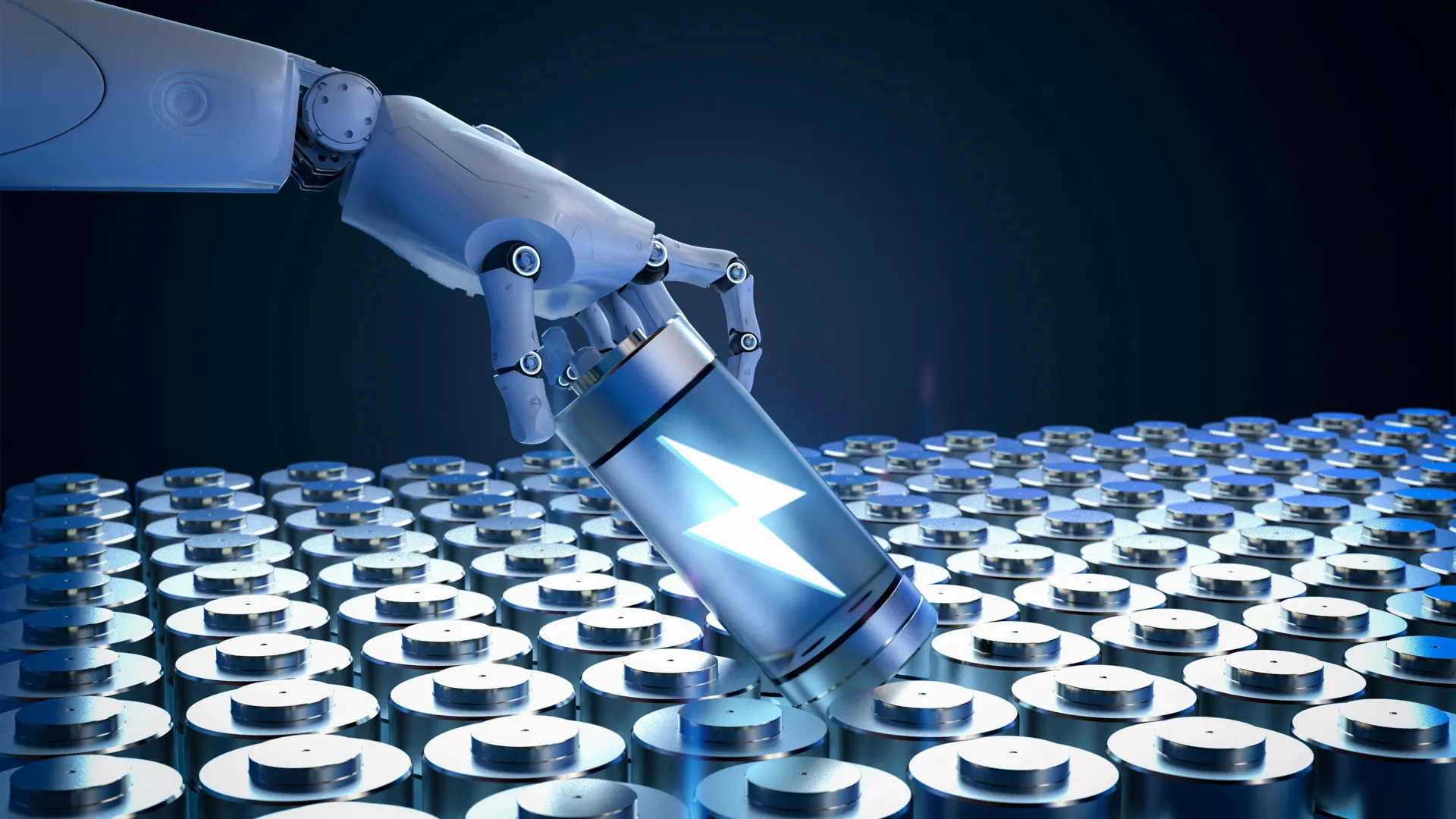
Artificial intelligence is revolutionizing the search for sustainable energy solutions. Recently, AI discovers new battery materials that could transform how we store electricity. Researchers at New Jersey Institute of Technology have made a breakthrough in battery technology. Their work focuses on finding alternatives to lithium-ion batteries. These traditional batteries face supply shortages and environmental concerns.
Furthermore, the research team, led by Professor Dibakar Datta, published their findings in Cell Reports Physical Science. They successfully applied generative AI techniques to identify promising battery materials. Specifically, they targeted multivalent-ion batteries as potential replacements. These batteries use abundant elements like magnesium, calcium, aluminum, and zinc. Consequently, they offer cost-effective and sustainable alternatives to current technology.
Traditional lithium-ion batteries rely on lithium ions with single positive charges. However, multivalent-ion batteries use elements with two or even three positive charges. This fundamental difference means they can potentially store much more energy. Therefore, these batteries are highly attractive for future energy storage needs.
Nevertheless, challenges exist with multivalent-ion technology. The larger size and greater electrical charge of multivalent ions create difficulties. These ions are hard to accommodate efficiently in battery materials. Fortunately, the NJIT team’s AI-driven approach directly addresses this obstacle.
“One of the biggest hurdles wasn’t a lack of promising battery chemistries,” explained Datta. “It was the sheer impossibility of testing millions of material combinations.” The research team turned to generative AI as a solution. This approach provides a fast, systematic way to explore vast material landscapes. Consequently, it helps identify structures that could make multivalent batteries practical.
Moreover, the approach allows researchers to explore thousands of potential candidates quickly. This dramatically speeds up the search for efficient and sustainable alternatives. Traditional laboratory experiments would take much longer to achieve similar results.
To overcome these technical challenges, the NJIT team developed a novel dual-AI approach. They created a Crystal Diffusion Variational Autoencoder and a finely tuned Large Language Model. Together, these tools rapidly explored thousands of crystal structures. Previously, such exploration was impossible using conventional experimental methods.
Additionally, the CDVAE model was trained on extensive datasets of known crystal structures. This training enabled it to propose completely novel materials. These materials have diverse structural possibilities for battery applications. Meanwhile, the Large Language Model focused on materials closest to thermodynamic stability. Such stability is crucial for practical synthesis in real-world conditions.
“Our AI tools dramatically accelerated the discovery process,” stated Datta. The tools uncovered five entirely new porous transition metal oxide structures. These materials show remarkable promise for battery development. Additionally, they have large, open channels ideal for moving bulky multivalent ions. This characteristic is critical for next-generation battery performance.
The research team validated their AI-generated structures thoroughly. They used quantum mechanical simulations and stability tests for confirmation. These validations confirmed that the materials could be synthesized experimentally. Furthermore, the materials hold great potential for real-world applications.
Importantly, Datta emphasized the broader implications of their AI-driven approach. “This is more than just discovering new battery materials,” he noted. “It’s about establishing a rapid, scalable method to explore any advanced materials.” This approach could benefit electronics, clean energy solutions, and other fields. It eliminates extensive trial and error from traditional material discovery.
With these encouraging results, the research team plans future collaborations. They will work with experimental labs to synthesize and test their AI-designed materials. Such partnerships will push the boundaries toward commercially viable multivalent-ion batteries. Additionally, this research opens doors for other AI-assisted material discoveries.
The implications of AI discovers new battery materials extend beyond laboratory settings. As global demand for energy storage grows, sustainable alternatives become essential. Lithium mining raises environmental and geopolitical concerns. Therefore, developing abundant-element batteries addresses these critical issues.
Multivalent-ion batteries offer several advantages over current technology. They use more readily available materials, reducing supply chain risks. Their higher energy density could improve device performance. Additionally, they may prove more environmentally friendly throughout their lifecycle.
The dual-AI approach demonstrates the power of machine learning in scientific research. Traditional methods often require years to explore material possibilities. However, AI can process vast datasets and identify promising candidates rapidly. This acceleration enables researchers to focus on practical testing and development.
Looking ahead, AI discovers new battery materials represents just the beginning. The methodology could revolutionize materials science across industries. From semiconductors to pharmaceuticals, AI-assisted discovery shows tremendous potential. Moreover, the success of this project validates machine learning’s role in solving complex scientific challenges.
The collaboration between computational modeling and experimental validation proves crucial. AI generates promising candidates, but laboratory testing confirms practical applications. This partnership ensures that theoretical discoveries translate to real-world innovations. Therefore, continued investment in both AI research and experimental facilities remains essential.
As energy demands continue growing, sustainable storage solutions become increasingly important. AI discovers new battery materials that could meet these future needs. The NJIT research demonstrates how technology can address global challenges. Furthermore, it shows the potential for artificial intelligence to accelerate scientific breakthroughs.
The transition to sustainable energy storage requires innovative approaches. AI discovers new battery materials through efficient exploration methods. This research contributes to a more sustainable energy future. Additionally, it establishes frameworks for future material discoveries. The combination of advanced computing and scientific expertise creates powerful possibilities.
Ultimately, the success of multivalent-ion batteries depends on continued research and development. AI discovers new battery materials that show promise, but practical implementation requires further study. Nevertheless, this breakthrough represents significant progress toward sustainable energy storage solutions.
In conclusion, the NJIT research exemplifies how artificial intelligence transforms scientific discovery. AI discovers new battery materials that could revolutionize energy storage technology. This advancement addresses both environmental and economic challenges. The research paves the way for more sustainable battery technologies. Furthermore, it demonstrates AI’s potential to solve complex global problems.