
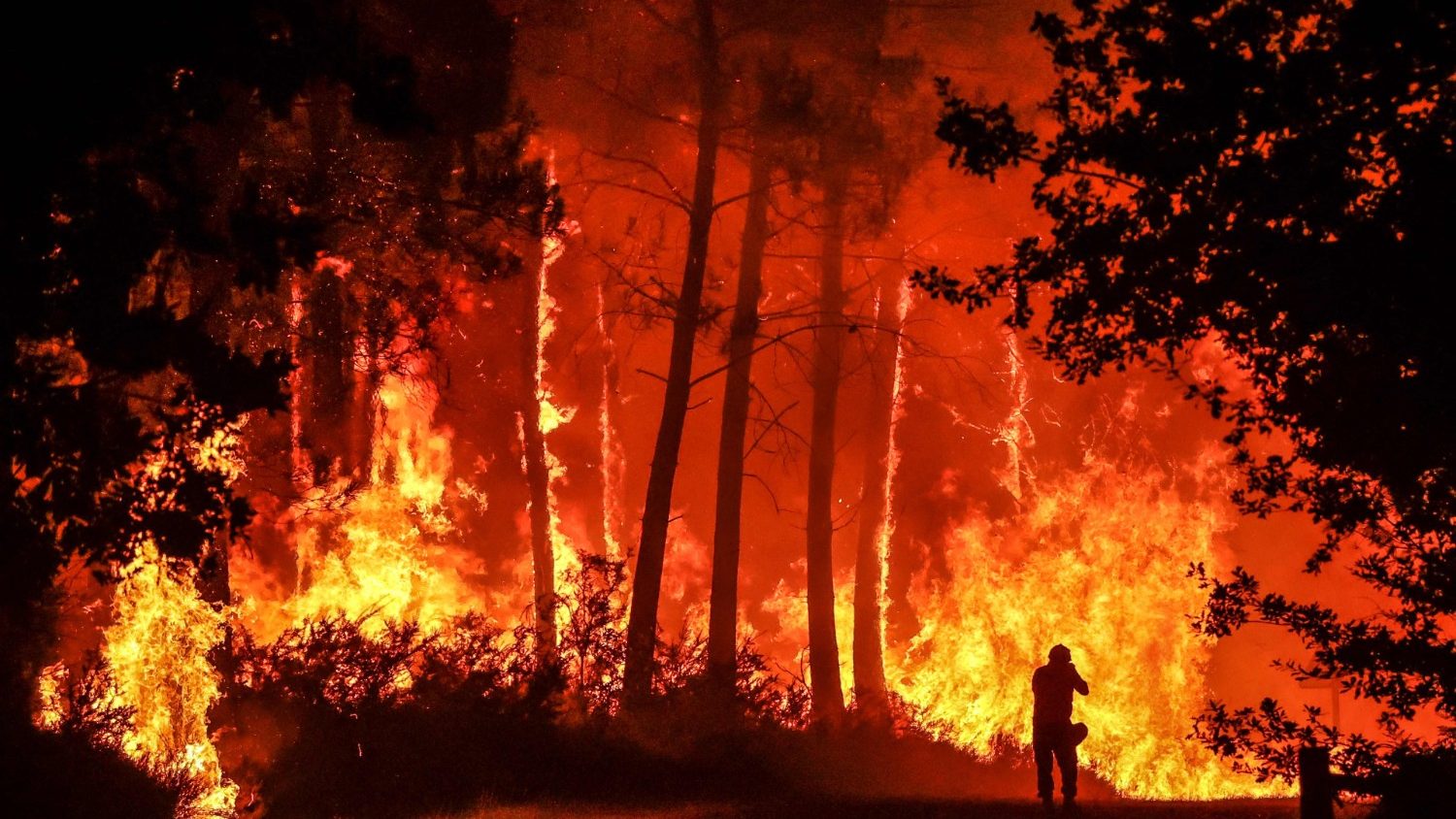
The France Wildfire 2025 has quickly escalated into the worst fire of the year. It has already scorched 13,000 hectares—more than the size of Paris. As a result, entire villages in southern France are under threat, while firefighters struggle to contain the fast-moving blaze.
The fire erupted near Saint-Laurent-de-la-Cabrerisse, roughly 30 kilometers from Perpignan. According to local authorities, at least one person has died, and over 25 homes have burned. Furthermore, roads remain blocked, and about 2,500 households are without power. Nearly 2,000 firefighters are battling to bring the situation under control, yet the fire’s speed presents enormous challenges.
Tourists and residents were forced to flee with little warning. For instance, Dutch tourist Renate Koot said the fire moved so fast that they had no time to pack. One minute they saw smoke, the next they were escaping in their car, praying for safety. Likewise, Spanish visitor Issa Medina called it a “catastrophe,” noting how chaotic the evacuation became.
Moreover, authorities reported the fire spreading at 5.5 km/h, making firefighting efforts difficult. Firefighter spokesperson Eric Brocardi described the scale as “unprecedented” and emphasized how unpredictable the fire’s path had become due to wind shifts.
Importantly, scientists believe this disaster is directly linked to climate change. With hotter and drier summers, the Mediterranean region has become increasingly prone to wildfires. Climate analyst Serge Zaka warned that fire seasons will now extend into spring and autumn, covering more of France over time. Consequently, risk levels are rising, even in areas previously unaffected.
Other countries in southern Europe are also facing dangerous conditions. In Spain, a record-breaking heatwave has pushed temperatures above 43°C. Several wildfires have already erupted, fanned by the intense heat. For example, in Tarifa, a popular kitesurfing resort, a blaze started when a caravan caught fire. Authorities had to restrict access to hotels, restaurants, and campsites.
In the northwestern region of Galicia, firefighters evacuated the village of Corme Aldea after a fire approached homes in Ponteceso. Emergency teams are now working around the clock to keep the flames from spreading further.
Meanwhile, Portugal has experienced a sharp increase in wildfires this year. So far, over 42,000 hectares have burned—eight times more than the same period in 2024. Alarmingly, more than half of that damage occurred in the past two weeks. Near Vila Real, firefighters finally brought a major blaze under control after five days, during which temperatures soared above 40°C.
Across the region, the combination of extreme heat, dry vegetation, and strong winds has created a perfect storm for fire outbreaks. Although firefighting units are highly trained, nature’s fury continues to outpace containment strategies. Moreover, shifting wind patterns can reignite areas that had previously been under control.
The France Wildfire 2025 reveals a troubling truth: Europe’s climate is changing faster than its emergency systems can adapt. Fires are no longer isolated incidents. Instead, they are becoming widespread events that disrupt communities, destroy livelihoods, and threaten biodiversity.
Therefore, governments must urgently rethink their fire prevention strategies. Investing in climate-resilient infrastructure, early warning systems, and cross-border cooperation will be essential. As this year’s fires show, no region is immune to the effects of global warming.
Ultimately, the France Wildfire 2025 is a wake-up call. The flames that engulfed forests and homes also ignited a deeper debate about climate preparedness, public safety, and political will. What happens next will define how Europe adapts to its fiery new reality.