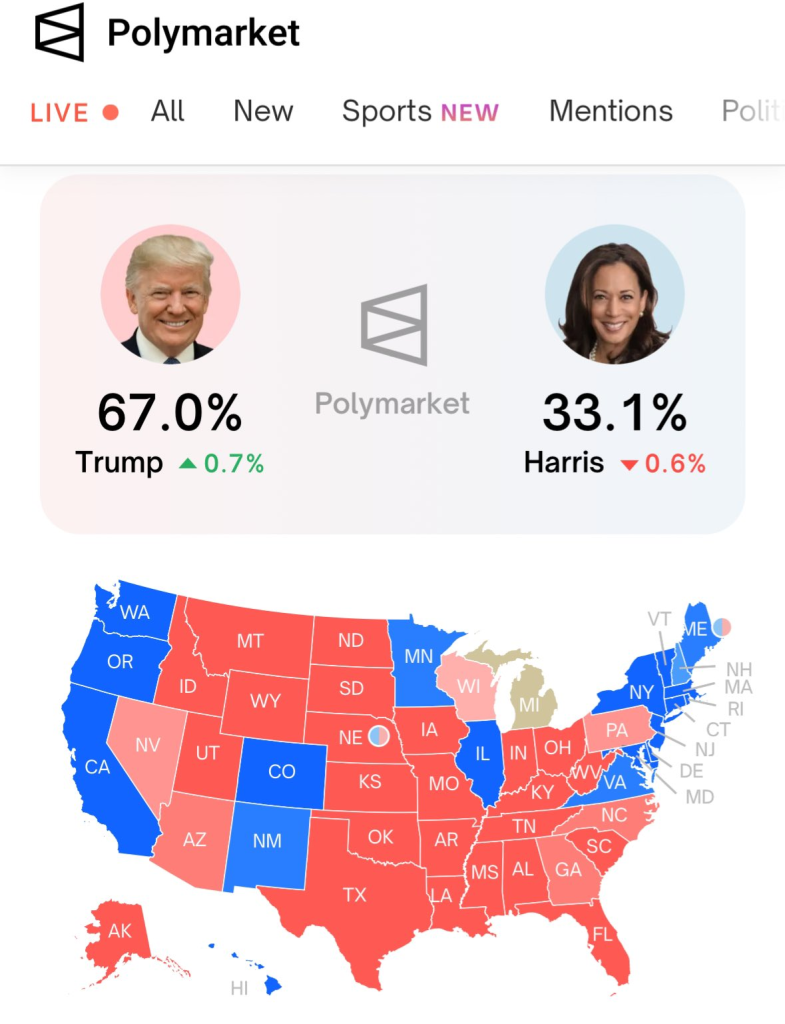

As the 2024 U.S. presidential election draws closer, recent projections show former President Donald Trump with a significant lead over Vice President Kamala Harris in the race for the White House. With a projected support rate of 67% for Trump compared to Harris’s 33.1%, these numbers paint a vivid picture of the evolving dynamics of the election. This substantial lead, illustrated through a predominantly red electoral map, reflects the potential electoral shift in favor of Trump across many states.
In this article, we dive into the factors driving this projection, analyzing the political climate, key battleground states, voter demographics, and campaign strategies that will likely shape the 2024 election. As Trump’s support base rallies behind his bid for a second term, Harris faces the challenge of galvanizing a coalition of Democratic voters to counter his momentum. The stage is set for an intense contest, as both candidates navigate a polarized political landscape, aiming to secure the highest office in the land.
Trump’s Resurgence and the MAGA Movement
One of the most significant factors contributing to Trump’s lead is the resilience of his “Make America Great Again” (MAGA) movement, which has grown into a political phenomenon. Despite controversies and legal challenges, Trump’s brand of populism and America-first policies continue to resonate with a large segment of the population. His campaign promises of economic growth, reduced government intervention, and national security appeal to conservative voters who feel left behind by the current administration.
Trump’s base remains highly motivated and vocal, drawn to his unfiltered approach and commitment to conservative ideals. Since his 2020 election loss, Trump has maintained an active presence in the political arena, endorsing candidates and holding rallies that reinforce his influence within the Republican Party. The MAGA movement’s grassroots support is likely to be a powerful force as Trump seeks to expand his reach beyond the GOP’s traditional strongholds, appealing to independents and swing voters who may be disillusioned with the current direction of the country.
Harris’s Path to Unifying the Democratic Base
Vice President Kamala Harris, as the presumptive Democratic nominee, faces the daunting task of uniting a diverse coalition of voters to compete with Trump’s solidified base. As the first woman of color to hold the vice presidency, Harris has a unique appeal to a broad array of Democratic constituencies, including women, minorities, and younger voters. However, her favorability ratings have fluctuated, and she has encountered challenges in defining her public image beyond her role in the Biden administration.
Harris’s campaign will likely emphasize issues such as healthcare, climate change, and social justice, which resonate strongly with progressive Democrats. At the same time, she must balance these priorities with the concerns of moderate and independent voters, especially in swing states. To increase her chances, Harris will need to craft a narrative that appeals to a broad base while mobilizing high voter turnout among groups that were crucial to the Democratic victory in 2020.
Battleground States and the Road to 270 Electoral Votes
As in every presidential election, the battle for key swing states will be decisive in 2024. The projected electoral map shows a significant portion of these battlegrounds leaning toward Trump, which could be a crucial advantage if it holds until election day. Key states to watch include:
- Pennsylvania
Pennsylvania has been a pivotal state in recent elections, swinging from Trump in 2016 to Biden in 2020. The state’s diverse voter base—comprised of urban, suburban, and rural areas—makes it a complex battleground. Trump’s messaging on economic revival and energy independence, particularly in coal and natural gas sectors, could resonate in Pennsylvania’s industrial regions. Conversely, Harris may appeal to urban and suburban voters with her stance on social issues and economic equity. - Michigan and Wisconsin
Like Pennsylvania, Michigan and Wisconsin were part of the “Blue Wall” that Trump broke in 2016 but Biden reclaimed in 2020. Trump’s focus on manufacturing jobs and trade policies has appeal in these states, especially among working-class voters. Harris’s approach will likely center on strengthening unions and promoting job training and education to appeal to a broad cross-section of the electorate. - Florida
Florida has trended increasingly Republican in recent years, and Trump has a strong base in the state, partly due to his residency and popularity among Cuban-American and Venezuelan-American voters. Harris will face an uphill battle in this crucial state, where issues like immigration and economic growth for small businesses may play central roles. - Arizona and Georgia
Arizona and Georgia, both traditionally Republican, were won by Biden in 2020, signaling shifting demographics and political leanings. Arizona’s growing Latino population and Georgia’s burgeoning urban centers, particularly in Atlanta, could be advantageous for Harris. However, Trump’s strong base of rural and suburban supporters could make these states highly competitive. - Texas
Texas remains a Republican stronghold, but changing demographics and increased voter engagement have made it more competitive. Harris will likely focus on urban areas like Houston, Austin, and Dallas, where Democratic support has grown. For Trump, maintaining support in suburban and rural areas will be key to retaining Texas’s substantial electoral votes.
Voter Demographics and Key Issues
The 2024 election will be shaped by a variety of voter demographics, each with unique concerns and priorities. Understanding these groups will be essential for both candidates as they refine their campaign strategies:
- Suburban Voters
Suburban areas were a battleground in the 2020 election, with both parties making gains in different regions. Trump has a strong base among suburban voters who are concerned about issues like crime and property taxes. Harris will likely focus on healthcare, education, and environmental policies to appeal to suburban families, particularly women and younger voters. - Rural Voters
Trump’s support among rural voters remains strong due to his stance on issues like agricultural policy, gun rights, and economic opportunities in rural areas. Harris may face difficulties in these regions, as her policies on climate change and environmental protection may be perceived as limiting to rural industries. However, a targeted approach that addresses rural healthcare and infrastructure could help her make inroads. - Youth Voters
Younger voters tend to lean Democratic and are likely to be drawn to Harris’s progressive stance on climate change, social justice, and economic equity. Harris’s challenge will be to energize this demographic, which often has lower voter turnout rates. Engaging youth with clear, actionable policies could be crucial to her campaign. - Latino and African-American Voters
Both Trump and Harris will vie for support from Latino and African-American voters, groups that have shown varied political leanings in recent years. Trump’s appeal among Cuban-American and Venezuelan-American voters, particularly in Florida, is an asset, while Harris may have an advantage among African-American voters. However, both candidates will need to address issues like economic opportunity, healthcare access, and criminal justice reform to solidify support within these communities. - Senior Voters
Senior citizens have been a reliable voting bloc for Republicans, but Harris may seek to attract them by focusing on healthcare, Social Security, and Medicare. Trump’s approach will likely emphasize economic stability and conservative social values, aiming to maintain the loyalty of this crucial demographic.
The Key Campaign Strategies for Trump and Harris
Given the projected support levels, both Trump and Harris are expected to adopt strategic approaches to secure victory:
- Trump’s Campaign Strategy
Trump’s approach will likely focus on reinforcing his image as an outsider fighting against the political establishment, a narrative that has resonated with his supporters in the past. He may emphasize economic issues, foreign policy, and his commitment to conservative social values. Trump is also likely to maintain an aggressive campaign style, holding large rallies and using social media to mobilize his base. - Harris’s Campaign Strategy
Harris will need to balance her progressive values with an appeal to moderate and independent voters. Her campaign will likely highlight achievements in healthcare, environmental policy, and social justice. Harris may also focus on mobilizing young and minority voters, who are key to the Democratic coalition but often have lower turnout rates. - Debates and Public Appearances
Debates between Trump and Harris could play a significant role in shaping public opinion. Trump’s strong presence and experience on the debate stage will be an advantage, but Harris’s legal background and debating skills could help her counter his attacks. Both candidates’ performance in debates and public appearances will be closely scrutinized, with potential to sway undecided voters. - Digital and Grassroots Campaigning
The 2024 election is expected to heavily utilize digital campaigning, with both candidates investing in social media, targeted ads, and data analytics to reach voters. Harris may leverage her support among younger, tech-savvy voters, while Trump is likely to capitalize on his established digital presence. Grassroots efforts, such as door-to-door canvassing and local events, will also be essential in swing states and key demographics.
Conclusion
The 2024 U.S. presidential election promises to be a historic and closely watched contest. With Trump leading in projected support against Harris, both candidates will face the immense challenge of securing a broad coalition of voters while navigating a polarized political environment. For Trump, maintaining his base while appealing to undecided voters will be key, while Harris will need to unite the Democratic Party and energize her diverse coalition to stand a chance.
As the campaign progresses, the focus will shift to critical states, pivotal voter demographics, and the pressing issues facing the nation. Both Trump and Harris have a narrow path to victory, and each must overcome unique challenges. The outcome of the election will depend on how effectively they address the concerns of the American people and their ability to rally support in the months leading up to election day.
The stakes are high, and the future of the nation hangs in the balance. With each candidate representing vastly different visions for America, the 2024 election will undoubtedly shape the direction of the United States for years to come.